
AI Privacy Compliance in Australia: The 2026 Reset
AI privacy compliance has become the fastest-moving obligation in Australian workplaces. Workers now paste customer records, resumes and incident reports into tools nobody formally approved, and every one of those actions sits squarely inside the Privacy Act 1988 (Cth). This guide sets out what has already changed, what commences in December 2026, and what your organisation should fix now.
Last updated on August 12, 2026
Why AI Privacy Compliance Is Now a Board-Level Issue
The tools arrived before the policies did
Generative AI entered most Australian organisations sideways. Nobody signed a procurement form. A worker opened a browser tab, found a free assistant, and started drafting faster.
Consequently, personal information began flowing into systems that were never assessed, never approved, and never covered by a collection notice. The productivity gain was immediate. The privacy exposure was invisible.
Personal information is moving through unmapped systems
Consider what actually gets pasted into an AI prompt during a normal week. Client names. Medical certificates. Performance notes. Complaint transcripts.
Each of those is personal information under Australian law, and some of it is sensitive information carrying stricter handling rules. Furthermore, many AI platforms retain inputs, use them for model improvement, and store them offshore — which converts an ordinary task into a cross-border disclosure.
Regulators have already moved on this
Australian privacy law did not wait for the technology to settle. The Privacy and Other Legislation Amendment Act 2024 introduced a statutory right for individuals to sue over serious invasions of privacy, new anti-doxxing offences, and a tiered civil penalty regime.
Moreover, transparency obligations for automated decision-making commence in December 2026. Organisations that use computer programs to make decisions significantly affecting people will need to say so, in plain terms, in their privacy policy.
Executive Summary
- What this blog covers: How the Privacy Act 1988 and the 13 Australian Privacy Principles apply when workers use AI tools, plus the reforms landing between now and December 2026.
- Who it’s for: Australian HR leaders, WHS managers, compliance officers, privacy officers, PCBUs and executives responsible for data handling decisions.
- Key regulatory context: Privacy Act 1988 (Cth), the Australian Privacy Principles, the Privacy and Other Legislation Amendment Act 2024, the Notifiable Data Breaches scheme, and officer duties under the WHS Act 2011.
- The central risk: Unapproved AI use creates undisclosed collection, uncontrolled disclosure and offshore storage of personal information — often without a single record that it happened.
- Primary action required: Map where AI touches personal information, approve a defined tool list, and train workers on the actual workflow rather than the policy on paper.
What AI Privacy Compliance Means Under Australian Law
The Privacy Act applies to AI without any exception
There is no separate rulebook for artificial intelligence in Australia. Instead, the Privacy Act 1988 (Cth) applies exactly as it always has, and the technology simply becomes another way that personal information gets collected, used, disclosed and stored.
Therefore, the question is never “does privacy law cover this AI tool?” The question is whether your existing handling of personal information still meets the Australian Privacy Principles once an AI system sits in the middle of the process.
The 13 Australian Privacy Principles in an AI context
The APPs form the operational core of Australian privacy law. Notably, several of them behave very differently once generative AI enters a workflow.
Below are the principles that most often break when workers adopt AI tools informally:
- APP 1 — Open and transparent management: your privacy policy must actually describe how information is handled, including AI-assisted handling.
- APP 3 — Collection of solicited information: collect only what is reasonably necessary, which AI prompts routinely exceed.
- APP 5 — Notification of collection: people must be told what happens to their information at the point of collection.
- APP 6 — Use and disclosure: feeding personal information into a third-party AI platform may constitute a disclosure.
- APP 8 — Cross-border disclosure: most mainstream AI tools process and store data offshore.
- APP 11 — Security of personal information: you remain accountable for information you can no longer retrieve or delete.
- APP 12 and 13 — Access and correction: individuals can ask what you hold, and AI outputs complicate that answer.
Personal information versus sensitive information
Personal information is any information about an identified individual, or one who is reasonably identifiable. Sensitive information is a narrower, higher-risk subset covering health, race, religion, sexual orientation, criminal record, union membership and biometrics.
Critically, sensitive information generally requires consent before collection. An AI-drafted return-to-work plan or an AI-summarised grievance file will frequently involve sensitive information, which raises the compliance bar sharply.
Why AI Privacy Failures Happen in Australian Workplaces
The common root causes
Privacy failures involving AI rarely stem from bad intent. Rather, they emerge from ordinary people solving ordinary problems under time pressure.
- No approved tool list exists, so workers choose their own.
- Policy language says “do not share confidential data” without defining what that means in an AI prompt.
- Training covers privacy in the abstract and never mentions AI at all.
- Managers model the behaviour themselves, which signals that it is acceptable.
- Nobody owns the decision, so the risk sits between IT, HR and legal.
Shadow AI is the dominant exposure
Shadow AI describes tools used inside an organisation without formal approval, oversight or visibility. It is the AI equivalent of shadow IT, and it spreads considerably faster because the barrier to entry is a free login.
By contrast with a procured enterprise system, shadow AI leaves no audit trail. You cannot produce records of what was disclosed, when, or to whom.
As a result, an organisation may be unable to assess a suspected breach properly — which itself creates difficulty under the Notifiable Data Breaches scheme, where assessment must be completed within 30 days.
Where the risk concentrates
Certain workflows attract AI use far more than others. Specifically, watch these four:
- Recruitment — screening resumes, drafting rejection letters, summarising interview notes.
- Performance and conduct — writing warnings, summarising complaints, preparing investigation reports.
- Customer service — drafting responses that quote account details or personal circumstances.
- Health and injury management — summarising medical certificates and return-to-work documentation.
Each of these routinely involves sensitive information. Ultimately, they are also the areas where an affected individual is most likely to complain to the regulator.
The Regulatory Landscape: Reforms, Penalties and Duties
What the 2024 reforms changed
The Privacy and Other Legislation Amendment Act 2024 delivered the most significant update to Australian privacy law in years. Importantly, it made privacy failures directly actionable by individuals rather than only by the regulator.
Four changes matter most for organisations using AI. Firstly, a statutory tort now allows individuals to sue for serious invasions of privacy. Secondly, new criminal offences target doxxing. Thirdly, a tiered civil penalty regime lets the regulator act on mid-level and administrative breaches instead of pursuing only the most serious cases. Finally, automated decision-making transparency obligations commence in December 2026.
How the OAIC approaches enforcement
The Office of the Australian Information Commissioner regulates privacy compliance nationally. In practice, the OAIC investigates complaints, conducts own-motion inquiries, accepts enforceable undertakings and pursues civil penalties through the courts.
Regulatory attention tends to concentrate on a predictable set of failures:
- Privacy policies that do not reflect what the organisation actually does with information.
- Collection notices that omit disclosure to third-party platforms.
- Offshore disclosure occurring without the steps APP 8 requires.
- Retention of personal information long after any lawful purpose has ended.
- Slow, disorganised or undocumented responses to a suspected eligible data breach.
For serious or repeated interference with privacy, penalties can reach the greater of $50 million, three times any benefit obtained, or 30% of adjusted turnover during the relevant period.
Where WHS duties intersect with privacy
Privacy is not the only exposure created by workplace AI. Under the WHS Act 2011, a PCBU must eliminate or minimise psychosocial risks so far as is reasonably practicable, and Safe Work Australia’s model code of practice treats surveillance, monitoring and low job control as recognised psychosocial hazards.
Accordingly, AI systems that monitor productivity, score performance or rank workers can trigger both regimes at once. Officers should therefore assess these tools for psychosocial impact alongside the privacy assessment, rather than treating the two as separate projects.
Leadership, Officer Due Diligence and AI Privacy Compliance
What due diligence looks like in practice
Officers cannot delegate their way out of this. Due diligence under Australian law requires active, demonstrable steps rather than an assurance from someone further down the structure.
- Acquire current knowledge of how AI is used across the organisation.
- Understand which operations involve personal and sensitive information.
- Ensure appropriate resources exist to assess, approve and monitor AI tools.
- Verify that reporting processes work — and that workers actually use them.
The behaviours leaders need to model
Culture follows leadership behaviour far more reliably than it follows policy documents. Consequently, what executives do with AI sets the real standard.
- Name the approved tools openly, and use only those tools yourself.
- Reward early disclosure of mistakes instead of punishing the person who reports.
- Ask “what data went into that?” as a routine, non-accusatory question.
- Revisit approvals quarterly, because AI vendors change their terms frequently.
Why generic training fails here
Off-the-shelf privacy modules describe the law competently. However, they cannot tell your worker whether pasting a specific client file into a specific tool breaches a specific internal policy.
That gap is where breaches happen. Training built around your actual policies, systems and scenarios closes it, because workers recognise the situation and know the correct action before the pressure hits.
Policy-as-Written Versus AI-as-Used
The gap that drives most breaches
Every organisation has two versions of its privacy controls. One lives in the policy library. The other lives in what people actually do at 4:45pm on a Friday.
Policy-as-written is orderly, complete and approved. AI-as-used is improvised, undocumented and shaped by whatever removes friction fastest.
Closing that distance is the entire task. Rather than writing a stricter policy, effective organisations study the real workflow and design controls that fit it.
Comparing the two states
The table below shows how the same obligation looks on paper against how it typically plays out in practice.
| Obligation | Policy-as-written | AI-as-used |
|---|---|---|
| Tool approval | Only approved systems may process personal information. | Whichever free tool loads fastest in the browser. |
| Collection notice | Individuals are told how information will be handled. | Notice predates AI and never mentions it. |
| Cross-border disclosure | Offshore transfers follow a documented assessment. | Data leaves Australia the moment a prompt is sent. |
| Records and audit | Handling is logged and reviewable. | No log exists, so a breach cannot be scoped. |
| Human oversight | A named person approves significant decisions. | AI output is copied, lightly edited and sent. |
Designing controls people will actually follow
Workers bypass controls that cost them time without an obvious reason. Therefore, the practical answer is a short approved-tool list, a clear red line about sensitive information, and one simple escalation path.
Simplicity beats comprehensiveness here. A three-rule standard that everybody follows protects far more information than a thirty-page policy that nobody opens.
The eCompliance Central AI Privacy Compliance Framework
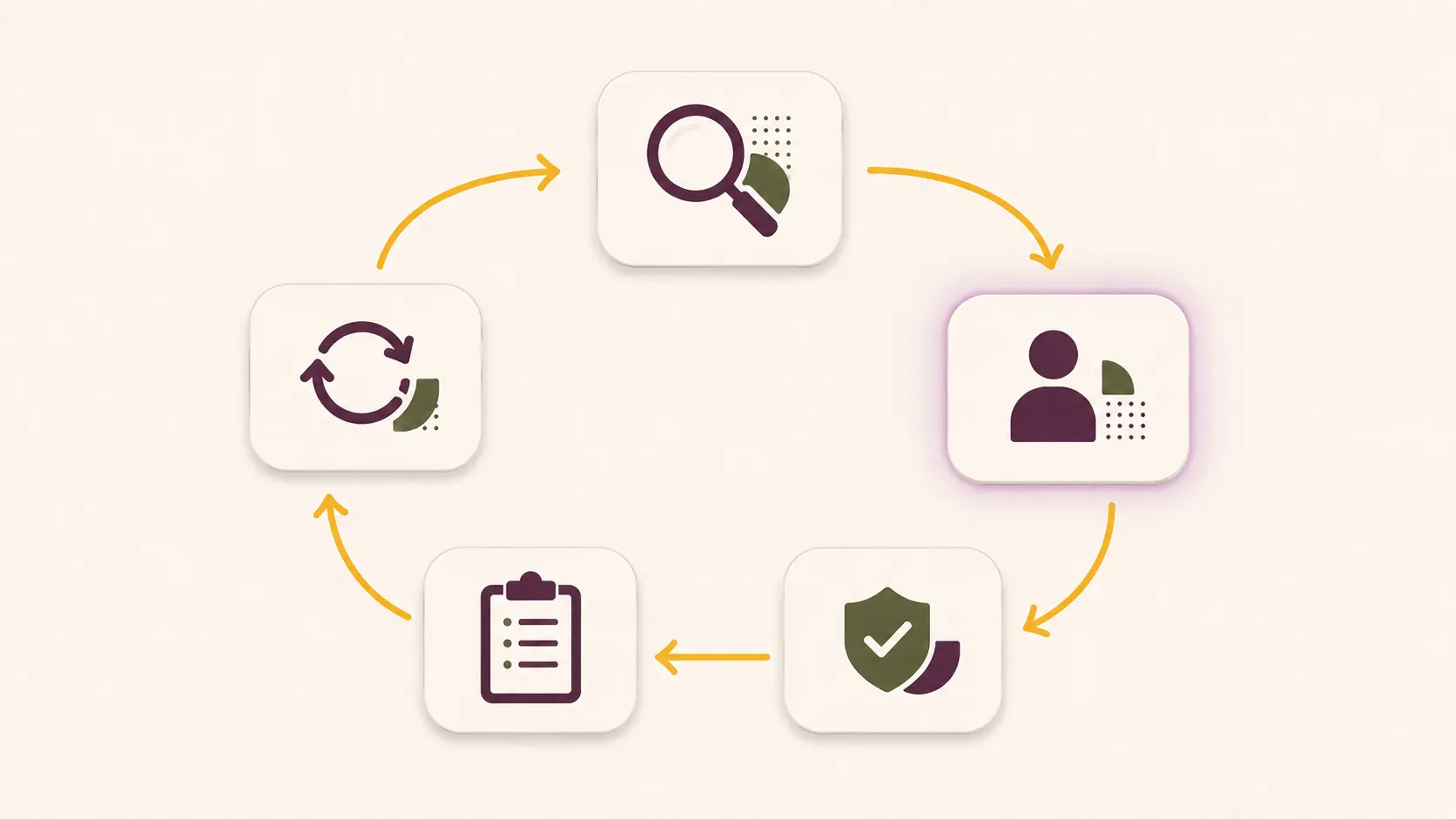
Most organisations do not need a transformation programme to address this. Instead, they need eight practical steps executed in order, with a named owner for each one.
An 8-Step Framework for Control
Map Your AI Footprint
Identify every AI tool currently in use, including the unapproved ones. Ask teams directly, because network logs will miss personal devices.
Classify the Information
Sort what flows through those tools into personal, sensitive and non-personal categories. Sensitive information should carry an immediate red line.
Publish an Approved List
Name the tools workers may use and the tasks each one covers. Ambiguity drives people back to whatever they were already using.
Rewrite Your Notices
Update the privacy policy and collection notices so they describe AI-assisted handling accurately. Transparency obligations begin with what you disclose.
Assign Human Oversight
Place a named decision-maker between any AI output and a decision affecting a person. Oversight must be real, not a rubber stamp.
Prepare for December 2026
Document which automated systems make or substantially influence significant decisions. Draft the disclosure wording well before the obligation commences.
Rehearse Breach Response
Run a live simulation using a realistic AI scenario. Test whether you could scope, assess and report within the 30-day window.
Train the Real Workflow
Deliver scenario-based training built on your own policies and systems. Generic modules teach the law but not the decision.
How to Choose the Right AI Privacy Training
Buyers face a crowded market, so use a short set of criteria rather than a feature list. Ask each provider these questions before committing:
- Currency: does the content already address the 2024 reforms and the December 2026 automated decision-making rules?
- Customisation: can scenarios be rebuilt around your policies, your systems and your sector?
- Experience: how many years has the provider spent designing workplace learning, as opposed to hosting it?
- Ownership: do you keep the content, or does access disappear when a subscription lapses?
- Delivery: is the module SCORM-ready for your own LMS?
- Evidence: does completion data demonstrate applied judgement, or only attendance?
Our own answer draws on more than 35 years of learning design experience and a library of 35+ compliance courses, delivered without subscription lock-in. Notably, that structure matters most when legislation shifts mid-year and content needs updating fast.
What Weak AI Privacy Controls Actually Cost
The financial and legal exposure
Penalties now sit at a level that reshapes budgets. Beyond the civil penalty regime, the statutory tort creates a second, independent path to liability that operates entirely outside regulator action.
How a single unapproved prompt escalates:
- A worker pastes a client file into an unapproved tool to save twenty minutes.
- That information is retained offshore, triggering questions under APP 6, APP 8 and APP 11.
- The affected individual discovers it, complains to the OAIC, and separately considers civil action.
The damage that does not appear on an invoice
Reputational harm outlasts any penalty. Clients who learn their information was handled carelessly rarely return, and prospective clients read the coverage for years afterwards.
Internally, trust erodes just as quickly. Workers who watch a colleague disciplined for something the organisation never trained them on will disengage from every future compliance initiative.
Compliance Intelligence: Key Insights
Key Takeaways
- Map every AI tool touching personal information, including the ones nobody approved.
- Classify sensitive information first, then draw an unambiguous red line around it.
- Publish a short approved-tool list that names permitted tasks explicitly.
- Rewrite privacy policies and collection notices so they describe AI-assisted handling.
- Assign a named human decision-maker to any AI-influenced decision about a person.
- Rehearse your breach response against a realistic AI scenario before you need it.
- Train workers on your actual systems and policies, not on privacy law in the abstract.
Frequently Asked Questions
Obligations and legal requirements
Does the Privacy Act apply when we use AI tools at work?
What changes in December 2026 for automated decision-making?
Can individuals sue our organisation over a privacy breach?
Practical steps and common mistakes
What should we do if a worker pasted personal information into an AI tool?
How often should privacy training be refreshed in Australian organisations?
Is AI monitoring of workers a WHS issue as well as a privacy issue?
Build AI Privacy Confidence Before December 2026
Our updated Privacy and AI at Work course covers the Privacy Act 1988, all 13 Australian Privacy Principles, safe AI use, the 2024 reforms and the automated decision-making rules commencing December 2026. Alternatively, start by working out exactly which modules your organisation needs.
Explore Custom Compliance Solutions
Looking for a broader overview?
Read our definitive Australian Workplace Compliance Guide.